
Sarcomas are rare cancers, accounting for < 1% of all malignancies. They originate in either bone or soft tissue. Melanoma cancers are more prevalent, occurring in about 1 in 38–58 people. Learn more on how Hyperthermia can help.
888-580-5900
Sarcomas are rare cancers, accounting for < 1% of all malignancies. They originate in either bone or soft tissue. Melanoma cancers are more prevalent, occurring in about 1 in 38–58 people. Learn more on how Hyperthermia can help.

Soft tissue sarcomas can arise in muscles and tendons, fibrous tissue, synovial tissue, fat, blood vessels, and nerves. Nearly 12,000 new cases of soft tissue sarcomas occur each year in the United States. Approximately 60% of soft tissue sarcomas arise in the extremities, with lower extremities three times more likely to be affected than upper extremities.
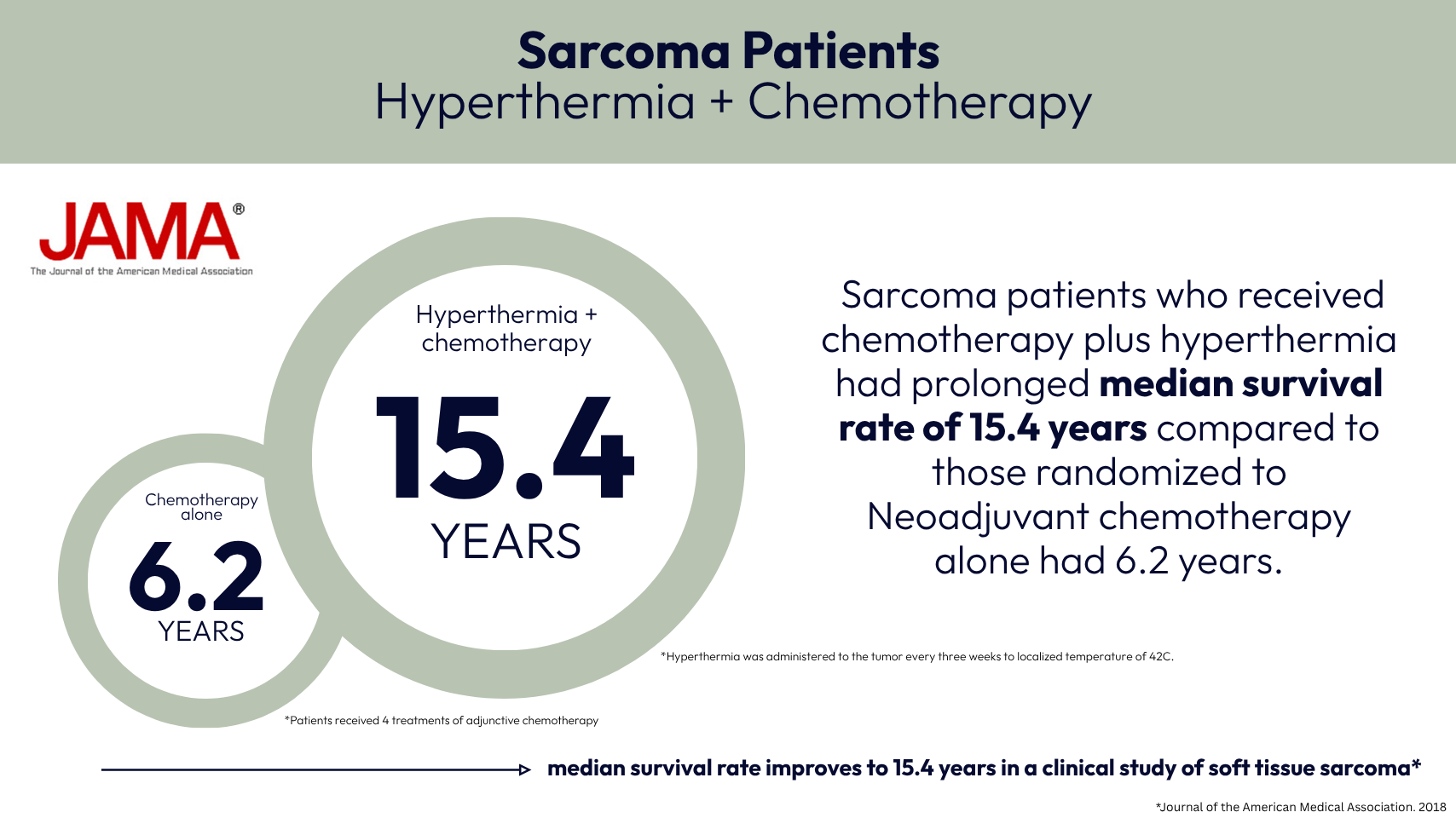
Hyperthermia increases the likelihood of a complete response in melanoma cancers by upwards of 50% when combined with radiation therapy.

Breast Vernon CC et al. and van der Zee et al., Int. J. Radiation Oncology Biol. Phys. 1996; 35(4) 731-744 Head & Neck Valdagni et al., Int. J. Radiation Oncology Biol. Phys. 1994; 28: 163-169
Melanoma Overgaard J et al., Int. J. Hyperthermia 1996; 12(1): 3-20 Cervical van der Zee et al. Int. J. Hyperthermia 2002; 18(1): 1-12, Berdov, BA and Menteshashvili, GZ.
Thermoradiotherapy of patients with locally advanced carcinoma of the rectum. Int. J. Hyperthermia 1990; 6(5): 881-890
When considering sarcoma treatment in Irvine, the histological grade, location, size of the primary tumor, and stage are most important. Due to the large variety of types of soft tissue sarcomas, treatment plans need to be individualized. Depending on the clinical circumstances, surgery, chemotherapy, or radiation therapy might be part of the treatment plan. Hyperthermia can be combined with any sarcoma treatment for best results.
Several types of benign or non-cancerous bone tumors can become cancerous. The most common cancerous bone tumors are plasma cell tumors that arise from bone marrow, and osteosarcomas, chondrosarcomas and Ewing’s sarcomas, which are from the bone itself. Bone sarcomas are rarer than soft tissue sarcomas, with about 3,000 new cases in the United States each year.
“My mom received hyperthermia here in conjunction with five rounds of chemotherapy for her stage four lung cancer. She saw a reduction in tumor burden by over 50% and her cancer stabilized.The team at HCI is thoughtful and caring – I recommend hyperthermia for all cancer patients undergoing chemo or radiation.”
“I just wanted to let you know that I am in my first cancer-free year! Thank you again for the time, effort and care given to me during my time of need. I will continue to spread the word of incredible hyperthermia treatments to those in need.”
– Merry Chase
“The hyperthermia treatments were the major difference in treating my cancer. I am forever grateful for this technology.”
– Carla Olson

The team at HCI is outstanding. They treated us with so much care and respect! The technology helped my wife tremendously and the treatment is relatively comfortable compared to many cancer therapies. We highly recommend. Oh, and it is in one of the most beautiful places on the planet!
I went to Hyperthermia cancer institute 5-6 days a week for 4 weeks. On my birthday, I received a call from my oncologist and they could not find a trace of tumor in the MRI. The tumor went to a zero! It is a complete success.
Dr. Pinzone and the whole team are fantastic and truly care about their patients. I highly recommend!
My mom received hyperthermia here in conjunction with five rounds of chemotherapy for her stage four lung cancer. She saw a reduction in tumor burden by over 50% and her cancer stabilized. I recommend hyperthermia for all cancer patients undergoing chemo or radiation.
The team at HCI is outstanding. They treated us with so much care and respect! The technology helped my wife tremendously and the treatment is relatively comfortable compared to many cancer therapies. We highly recommend. Oh, and it is in one of the most beautiful places on the planet!
I went to Hyperthermia cancer institute 5-6 days a week for 4 weeks. On my birthday, I received a call from my oncologist and they could not find a trace of tumor in the MRI. The tumor went to a zero! It is a complete success.
Dr. Pinzone and the whole team are fantastic and truly care about their patients. I highly recommend!
Hyperthermia treatment is non-invasive and non-toxic. There is no damage to normal healthy tissues during your session, meaning it can maximize the efficacy of other treatments like radiation and chemo without risking damage to vital organs. Most patients find it easy to tolerate and do not experience side effects.
While hyperthermia is most commonly paired with radiation or chemotherapy, it can also enhance outcomes when used in conjunction with surgery, especially for addressing residual cancer cells post-surgery. Your doctor will advise if this combination is suitable for your case.